A Town That Never Chose One History
The Chinese fishing nets on the waterfront, said to have arrived with traders connected to the court of Kublai Khan in the 14th century, still work the tide every evening. Mattancherry's 16th-century Jewish Synagogue and the Dutch Palace's Ramayana murals sit within walking distance of each other in Jew Town, alongside spice traders whose shopfronts haven't changed much in decades.
Fort Kochi and its neighbouring quarter, Mattancherry, together form a small peninsula — sometimes called Old Kochi or West Kochi — that has been absorbed, fortified, traded through, and resettled by more outside powers than almost anywhere else on India's west coast. Unlike most heritage towns, none of this is preserved behind glass. The nets still fish. The synagogue still holds services. The palace murals are original, not replicas.
It's compact and entirely walkable, which makes it a natural base for a day or two either side of a longer Kerala trip — most travellers combine it with Kochi's international airport connections rather than visiting it as a standalone destination.
Portuguese, Dutch, British — In That Order
In September 1503, the Rajah of Kochi granted the Portuguese permission to build a fort along the Arabian Sea waterfront, in gratitude for military help against the Samoothiri (Zamorin) of Kozhikode. Construction began within weeks, using double rows of coconut-tree stems packed with earth. Named Fort Emmanuel after King Manuel I of Portugal, it was the first European fort built anywhere in Asia — and the reason the settlement behind it came to be called Fort Kochi.1
Fort Emmanuel built; St. Francis Church founded as a wooden chapel, rebuilt in stone by 1516.1,3
Dutch East India Company captures the territory, demolishes most Portuguese structures, renovates the palace at Mattancherry.1
British control follows; by 1806 what remained of Fort Emmanuel's walls had been largely dismantled.4
Fort Kochi becomes a heritage precinct within Kochi city — renamed from Cochin in 1996.
What makes Fort Kochi unusual isn't that it changed hands three times — plenty of Indian ports did. It's that each power left something still functioning today rather than a ruin to be interpreted: a working synagogue, an active church, a palace with its original murals, and a fishing technique still used for its original purpose.
The Chinese Fishing Nets — Older Than the Fort Itself
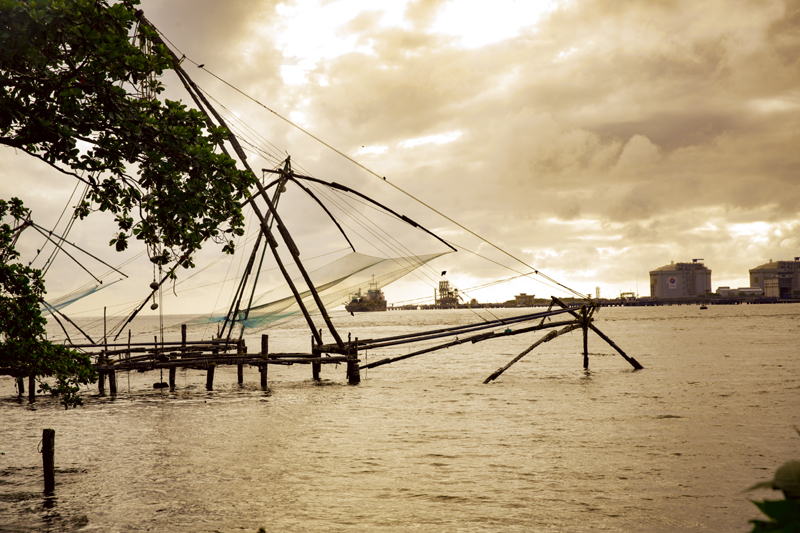
Photo © Dept. of Tourism, Govt. of Kerala
The cantilevered nets that have become Fort Kochi's most photographed sight predate the fort itself. Most accounts date their introduction to the 14th century — some sources place construction as early as 1350, connected to traders from the court of Kublai Khan, though the exact origin story is more folklore than documented record.5,6 What's certain is the mechanism: a fixed shore installation using cantilevers and stone counterweights to lower and raise a fine net, a system that requires no boat and can be worked by a small crew.
They're still commercially operated today, mostly along the harbour promenade near Vasco da Gama Square. Early morning and dusk are the best times to watch a full cycle — lowering, waiting, hauling — and to buy the catch directly from the fishermen, who often grill it to order at the stalls along the same stretch.
St. Francis Church — Where Vasco da Gama Was First Buried
St. Francis Church began as a wooden Portuguese chapel shortly after 1503 and was rebuilt as a permanent stone structure by 1516, making it the oldest European-built church in India.3,7 Vasco da Gama, who had opened the first direct European sea route to India in 1498, died in Kochi in December 1524 during his third voyage and was buried here. His remains were exhumed roughly fourteen years later and returned to Lisbon, where they remain today — but the original tombstone marker is still visible inside the church.3
The building itself tells its own layered story: it passed from Catholic to Dutch Reformed to Anglican use as each colonial power took control, and today functions as a Church of South India parish — still an active place of worship, not a museum piece.8
⛪ Nearby, Also Worth a Look
- Santa Cruz Basilica — originally built by the Portuguese, demolished by the British, and rebuilt in Gothic style by the late 19th century
- Fort Emmanuel remnants — a partially restored gun battery and rampart fragments near Fort Kochi Beach, free to visit
- Vasco House & Indo-Portuguese Museum — small collections covering the Portuguese period in more depth
Mattancherry — Spice Warehouses, a Synagogue, and Royal Murals
A short walk or auto-rickshaw ride from Fort Kochi proper, Mattancherry was historically the spice-trading quarter — and still smells like one. Jew Town's narrow lanes remain lined with warehouses that once handled pepper, cardamom and ginger bound for Europe and the Gulf.
The Paradesi Synagogue, built in 1568, sits at the heart of the quarter and is considered one of the oldest active synagogues in the Commonwealth.9 Its interior — hand-painted 18th-century Chinese willow-pattern floor tiles, Belgian glass chandeliers, and hand-lettered scrolls — reflects a Jewish community in Kerala with roots going back many centuries, though most of that community has since emigrated to Israel or elsewhere. It remains a working synagogue, closed Fridays, Saturdays, and Jewish holidays, and photography inside is not permitted.9,10
The Mattancherry Palace, commonly called the Dutch Palace, was originally built by the Portuguese as a gift to the Kochi Raja and later renovated by the Dutch in the 17th century — hence the name, even though the Dutch didn't build it.8 Its royal bedchamber holds some of the finest surviving examples of Kerala mural painting, depicting scenes from the Ramayana across the walls in extraordinary, still-vivid detail.
🕍 Visiting Respectfully
The Paradesi Synagogue and Mattancherry Palace both have specific, limited opening hours and dress expectations (shoulders and knees covered). Neither permits photography inside. Treat Jew Town as a living neighbourhood, not a photo backdrop — many shopfronts are still family-run businesses, some by the same families for generations.
The Kochi-Muziris Biennale — When History Becomes a Gallery
Founded in 2012, the Kochi-Muziris Biennale is India's largest contemporary art exhibition and one of Asia's most significant recurring art events, held roughly every two years across heritage warehouses, colonial-era buildings and public spaces throughout Fort Kochi and Mattancherry.11 The most recent edition ran from December 2025 to March 2026; the format typically spans December through March or April, so it's worth checking the Kochi Biennale Foundation's official announcements before timing a trip around it, since exact dates shift edition to edition.
What makes the Biennale distinctive isn't just the scale — it's the venues. Aspinwall House, a former spice-trading compound, and other disused colonial warehouses are converted into galleries for the duration, so the art sits inside the same layered history described throughout this guide rather than in a purpose-built museum. Locals sometimes call it the "People's Biennale" for its accessibility and the amount of free public programming — talks, workshops, and school visits — that runs alongside the main exhibition.12
Kathakali — A Living Theatre Tradition
Fort Kochi is one of the more reliable places in Kerala to see a tourist-accessible Kathakali performance, with several dedicated venues running shows most evenings. The typical format: a makeup demonstration around 5 pm, where performers are transformed into gods, demons, or heroes using elaborate natural-pigment face painting, followed by a 60–90 minute performance excerpting a story from the Mahabharata or Ramayana, usually with a spoken English introduction for visitors unfamiliar with the form.
Kathakali's defining feature is the navarasas — nine codified facial expressions performers train for years to control with precision, communicating emotion without dialogue. Several venues in the Fort Kochi area also pair the show with a short Kalaripayattu (Kerala's traditional martial art) demonstration on the same evening, since the two forms share some physical training roots.
🎭 Choosing a Venue
Standards and intimacy vary by venue and change over time, so check recent reviews before booking rather than relying on any single recommendation. Arrive by the stated makeup-session time if you want to see the transformation — it's often the most photographed part of the evening — and confirm whether the venue allows photography during the performance itself, since policies differ.
Food & Cafés — A Slower Kind of Kerala Eating
Fort Kochi's food scene reflects the same layering as its architecture: fresh Arabian Sea seafood grilled streetside near the fishing nets, old-fashioned Kerala meals served on banana leaf, and a growing scene of independent cafés set inside restored colonial-era bungalows — a look that's become closely associated with the neighbourhood since the Biennale began drawing an international art crowd in 2012.
Buying fish straight off the nets and having it grilled at an adjoining stall is one of the more memorable, unpretentious things to do here — agree on a price before they cook it. For a slower sit-down meal, look for restaurants serving a traditional Kerala sadya or fish moilee (a mild coconut-milk fish curry distinctive to the region) rather than the more generic multi-cuisine menus aimed squarely at tourists.
🏨 Base Yourself in Fort Kochi
Most of what's covered in this guide sits within a twenty-minute walk of Fort Kochi's heritage hotels and homestays — worth booking a night or two here even if the rest of your trip is elsewhere in Kerala.
When to Go and How Long to Stay
November through February is the most comfortable window — dry, with sea breeze off the harbour taking the edge off the heat. The Biennale, when it's on, adds a strong reason to visit in that same window, since its run typically spans December through March or April.
| Question | Short Answer |
|---|---|
| Best time to visit | November–February; avoid the heaviest monsoon months (June–August) for walking comfort |
| How long to stay | 1 full day for the core sights; 2 days to add Kathakali and unhurried café time |
| Getting there | Roughly 30–40 minutes from Cochin International Airport (COK) by road, or a ferry from Ernakulam mainland |
| Getting around | Walking or bicycle rental covers Fort Kochi and Mattancherry comfortably; auto-rickshaws for longer hops |
| Dress code notes | Cover shoulders and knees for the synagogue, palace and churches |
It pairs naturally with the rest of a Kerala itinerary as a start or end point, given its proximity to Kochi's airport — see our full destinations guide for how it fits alongside Munnar, Alleppey and the rest.
Common Questions — Answered
Sources & Further Reading
- Wikipedia. Fort Emmanuel. Historical record of the 1503 Portuguese fort at Fort Kochi Beach.
- Wikipedia. Fort Kochi. Overview of the Portuguese, Dutch and British administrative periods.
- Solo Inn Fort Kochi. About Fort Kochi. St. Francis Church construction history and the Vasco da Gama burial account.
- Kerala Tourism. Fort Immanuel, Fort Kochi. keralatourism.org — construction, reinforcement, and later demolition timeline.
- Kerala Travels. Fort Cochin Attractions. Chinese fishing net construction dating (1350–1450 AD).
- Incredible India (Ministry of Tourism, Government of India). Fort Kochi. incredibleindia.gov.in — 14th-century dating of the fishing nets.
- In The World's Jungle. Explore Colonial Fort Kochi. St. Francis Church and Mattancherry Palace historical notes.
- Green Earth Trails. Kochi Travel Guide. Church denominational history; Mattancherry Palace murals.
- AFAR. Fort Kochi. Paradesi Synagogue construction date and Commonwealth context.
- Outlook Traveller. Port Kochi: A Patchwork Quilt of Cultures. Visiting hours and practical heritage-site notes.
- Wikipedia. Kochi-Muziris Biennale. Founding year, edition history, and 2025–26 edition dates.
- India Art Expo. Kochi-Muziris Biennale 2025–26. Founders, venue format, and community programming.
Affiliate Disclosure: Some links on this page earn a small commission at no cost to you. See our Affiliate Disclosure for full details.