A Landscape That Was Never Just Scenery
In Kerala, nature was never something to be conquered. It was greeted, feared, thanked, and occasionally appeased. Long before forests were measured in timber value and rivers reduced to water resources, the landscape here carried presence. Trees listened. Rivers remembered. Mountains watched.
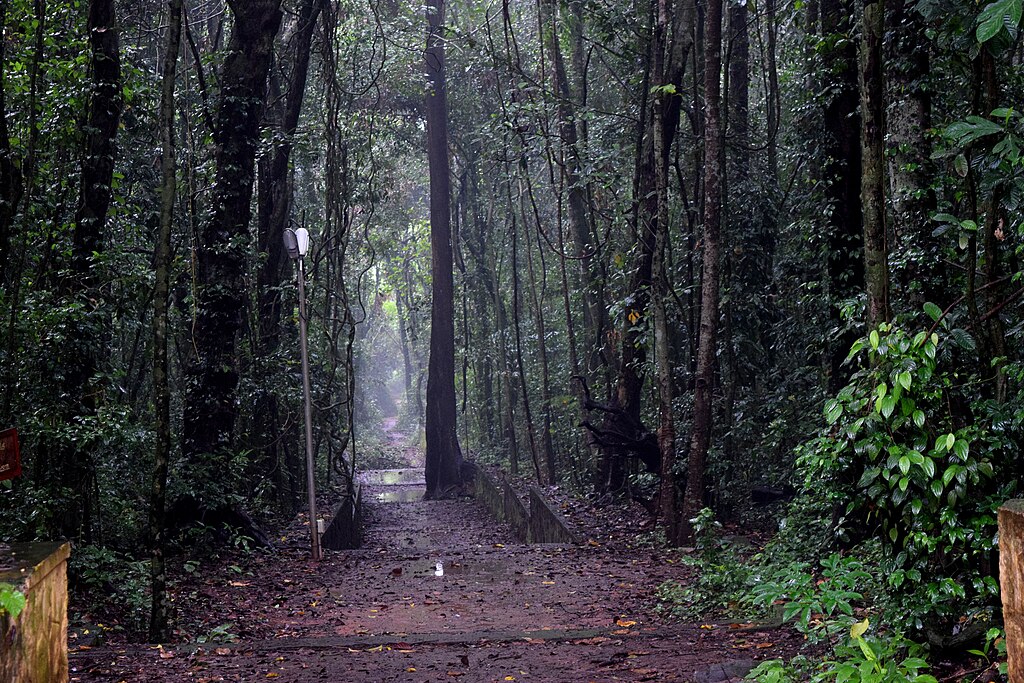
Iringole Kavu, Ernakulam — one of Kerala's largest surviving sacred groves, left deliberately untouched for generations.
Image Courtesy: Ranjithsiji, CC BY-SA 4.0, via Wikimedia Commons
To live in such a world meant accepting that humans were not at the centre of existence. They were participants — temporary, accountable, and deeply dependent. What modern language now calls eco-spirituality or indigenous belief systems was once simply everyday life.
This article explores how Kerala's people understood forests, snakes, rivers, and mountains not as symbols, but as living forces worthy of reverence. In doing so, they created one of the most enduring models of cultural conservation the world has known — one that modern ecology is only now beginning to measure and explain.
Seeing the World as Alive
The philosophical foundation of Kerala's nature worship lies in a simple but radical idea: the world is alive.
This worldview did not divide existence into sacred and secular spaces. There was no sharp boundary where religion ended and nature began. A forest patch could be a shrine. A river bend could demand ritual silence. A termite mound could hold divine presence.
Unlike organised temple religion, these belief systems did not require elaborate theology. They were rooted in experience — floods that nourished and destroyed, forests that fed and frightened, snakes that controlled pests yet threatened life. Respect grew not from abstraction, but from intimacy.
"Illness, infertility, or misfortune were understood as signs of imbalance, not punishment. Harmony, therefore, became survival."
— On Kerala's ritual ecologyTo harm nature was not a moral failure alone; it was a social and spiritual risk. Understood this way, protecting a grove or a river was never separate from protecting the community itself.
Forests as Deities — Where Gods Had Roots
Across Kerala's villages, small forest patches known as Kavu survived for centuries without fences or guards. These were not managed forests. They were untouched spaces — dense, dark, and deliberately left alone.
Each grove belonged to a deity, often a fierce mother goddess or a guardian spirit. Cutting a tree, removing soil, or even collecting fallen branches was traditionally forbidden. The forest was not maintained — it was respected.
🌳 What a Kavu Quietly Protected
- Cooled the surrounding land and buffered local microclimate
- Protected groundwater and nearby water sources
- Preserved plant species no longer found elsewhere in the region
- Kept a living record — stories of illness or misfortune following disrespect were passed down as warnings
Children grew up hearing stories of illness following disrespect. Elders remembered times when rituals were neglected and balance lost. Whether interpreted literally or metaphorically, the message remained clear: the forest was not human property.
Snakes as Cosmic Guardians — The World Beneath the Soil
Among all forms of nature worship in Kerala, none is as enduring — or as misunderstood — as serpent reverence.
The Sarpa Kavu, or snake grove, often existed within household land, yet remained untouchable. Here, snakes were not feared as predators alone, but revered as guardians of the underground world — water veins, fertility, and unseen life.
In agricultural societies dependent on monsoon rhythms, the snake symbolised continuity. It lived close to water, moved between worlds, and demanded restraint. Killing a snake or disturbing its grove was believed to fracture this balance.
From an ecological perspective, these groves preserved soil moisture, controlled rodent populations, and protected micro-habitats. From a cultural perspective, they enforced humility. Humans learned to share space with what they could not dominate. Fear, in this sense, was not the opposite of reverence — it was its guardian.
Rivers as Mothers and Goddesses — Water That Listens
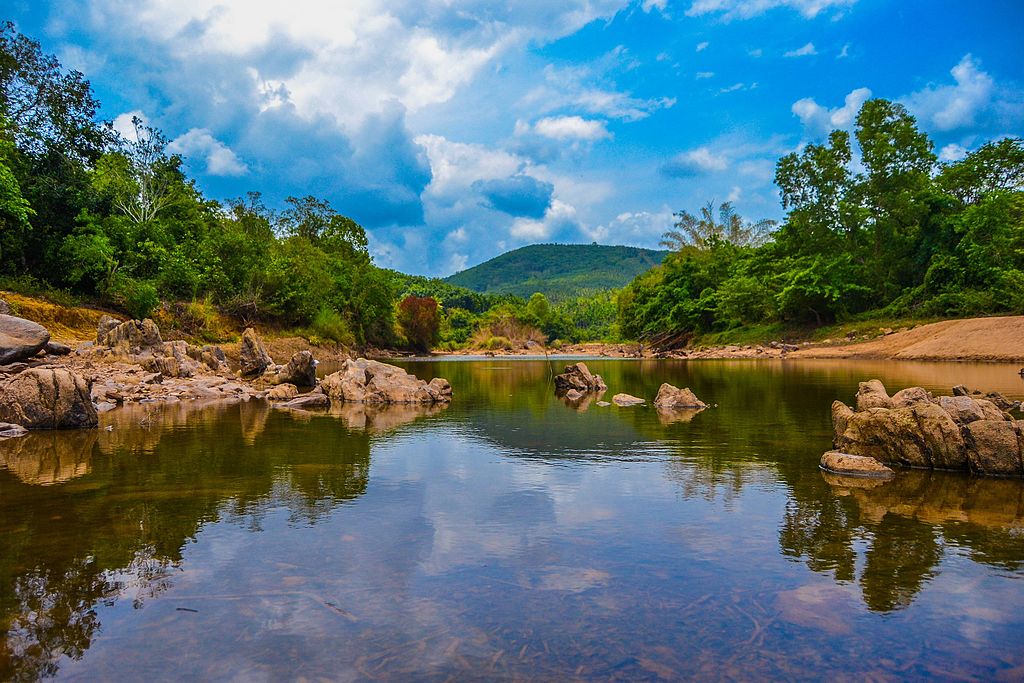
Chandragiri River, Kasaragod — one of Kerala's rivers long treated as a living presence rather than a resource.
Image Courtesy: Anikatipalla, CC BY-SA 4.0, via Wikimedia Commons
In Kerala, a river was never just a channel of flowing water. It was addressed, remembered, and sometimes apologised to.
Rivers such as the Bharathapuzha, Periyar, Pamba, and Chandragiri shaped settlement patterns, agricultural cycles, and ritual calendars. To pollute or obstruct a river was not merely an environmental error — it was a moral rupture. The river was understood as a living presence, capable of generosity and withdrawal.
Rituals along riverbanks were acts of relationship rather than worship alone. Offerings were made not to control water, but to acknowledge dependence. Bathing was both physical cleansing and symbolic realignment with natural rhythm.
In folk imagination, rivers carried memory. They witnessed births, journeys, and deaths. Seasonal flooding was not framed as disaster alone, but as renewal — soil replenished, fields restored, balance returned. When rivers dried or turned hostile, the cause was sought not in the river, but in human conduct.
Today, as rivers shrink under the weight of dams, sand mining, and pollution, the older language of reverence offers a painful contrast. What was once treated as a mother is now managed as an asset, and the consequences flow downstream.
Mountains as Ancestors and Ascetics
The Western Ghats rise along Kerala's eastern edge not as a backdrop, but as a presence. For centuries, these mountains were imagined as sages — silent, enduring, and watchful.
Peaks such as Agasthyarkoodam were not approached casually. Entry required preparation, restraint, and ritual discipline. Access was limited not through physical barriers, but through cultural understanding: mountains demanded respect, not conquest.
In many traditions, mountains were ancestral spaces. Forested slopes housed spirits, healers, and protectors. Cutting forests indiscriminately was believed to disturb forces far older than human settlement.
These beliefs created a form of ecological zoning long before environmental regulations existed. High ranges remained relatively untouched, serving as water sources, climate buffers, and biodiversity reservoirs for the plains below.
The idea that certain spaces should remain difficult, restricted, or even forbidden runs counter to modern tourism logic. Yet it is precisely this restraint that allowed mountain ecosystems to survive as long as they did.
Ritual Ecology — When Belief Became Law
Across forests, rivers, snake groves, and mountains, one pattern repeats: protection did not rely on enforcement, but on shared understanding.
Rituals functioned as reminders. Taboos acted as boundaries. Myths carried consequences. Together, they formed an unwritten ecological code that governed everyday behaviour.
There were no inspectors to patrol sacred spaces. Instead, stories did the work of regulation. Children learned early which places demanded silence, which required offerings, and which should not be entered at all.
This system worked because it was local, adaptive, and emotionally embedded. Nature was not protected for abstract future generations, but for immediate social balance — for health, fertility, and survival.
As these belief systems weaken under urbanisation and economic pressure, the loss is not merely cultural. It is ecological. When reverence fades, restraint fades with it. The lesson is not to revive rituals mechanically, but to recognise the wisdom they carried: ecosystems endure when humans know where not to interfere.
When Science Begins to Catch Up
What Kerala's indigenous belief systems preserved through reverence, modern science is now beginning to articulate through data.
Ecologists studying sacred groves, river systems, and forests repeatedly arrive at the same conclusion: ecosystems survive longest where human intervention is restrained, selective, and emotionally regulated.
🔬 What Field Studies Have Found
Sacred groves consistently show higher species diversity than surrounding cleared land. A 2015 survey of 15 major groves in Kannur and Kasaragod districts recorded 107 bird species across 48 families, including two Western Ghats endemics — the Malabar Grey Hornbill and the Rufous Babbler.12 Undisturbed riverbanks support stronger aquatic life, and forested mountains stabilise rainfall and temperature far beyond their physical boundaries.
What earlier societies expressed through myth and ritual, contemporary environmental science reframes as sustainability, resilience, and climate adaptation. The language has changed, but the insight remains strikingly similar. This convergence does not mean tradition needs scientific validation to matter — it simply reveals how deeply observation, experience, and survival shaped these belief systems.
Nature Worship in an Age of Tourism
Kerala today stands at a delicate intersection. Its landscapes draw global attention, while the cultural frameworks that once protected those landscapes continue to erode.
Nature worship was never designed for spectators. Sacred spaces were meant to be lived with, not consumed. When transformed into attractions, they risk losing the very restraint that allowed them to endure.
Responsible travel begins with understanding limits — knowing which spaces are meant for observation, which for participation, and which for distance. Wetlands, mangroves, village forests, and ritual landscapes form an interconnected ecological network, not isolated destinations.
For travellers willing to move slowly, listen carefully, and engage respectfully, Kerala still offers encounters with a living cultural ecology — quieter, less curated, and far more instructive than conventional tourism narratives.
🌿 Plan a Slow, Respectful Kerala Journey
If this guide has you thinking about seeing Kerala's sacred landscapes in person, base yourself near the backwaters or the Western Ghats and travel at a walking pace — that's where groves, rivers, and hill traditions are easiest to encounter respectfully.
What Is Lost When Nature Is No Longer Sacred
When forests become real estate, rivers become infrastructure, and mountains become viewpoints, something fundamental shifts. Protection turns conditional. Restraint becomes negotiable.
Sacredness once imposed limits without requiring constant justification. It asked humans to accept that not everything existed for use. In losing that framework, modern societies inherit the burden of regulation without reverence.
Kerala's traditions do not offer ready-made solutions for contemporary ecological crises. They offer something more difficult and more necessary: a way of seeing.
To see forests as presences, rivers as relationships, snakes as guardians, and mountains as elders is not to reject modern knowledge. It is to remember that survival once depended on humility. In a warming world searching for sustainable futures, this memory may be as valuable as any policy.
Common Questions — Answered
Sources & Further Reading
- Gadgil, M., & Guha, R. (1992). This Fissured Land: An Ecological History of India. Oxford University Press.
- Ramakrishnan, P. S. (1998). Conserving the Sacred: For Biodiversity Management. Oxford & IBH Publishing.
- Chandran, M. D. S. (1997). On the Ecological History of the Western Ghats. Current Science.
- Malhotra, K. C., Gokhale, Y., Chatterjee, S., & Srivastava, S. (2001). Cultural and Ecological Dimensions of Sacred Groves in India. Indian National Science Academy.
- Gadgil, M. (2011). Ecology Is for the People. Permanent Black.
- Kerala Forest Department. Sacred Groves of Kerala. forest.kerala.gov.in
- Posey, D. A. (1999). Cultural and Spiritual Values of Biodiversity. United Nations Environment Programme (UNEP).
- Folklore Academy, Government of Kerala. Studies on Nature Worship, Sarpa Kavu, and Ritual Ecology.
- Ingold, T. (2000). The Perception of the Environment: Essays on Livelihood, Dwelling and Skill. Routledge.
- Western Ghats Ecology Expert Panel (2011). Ecology, Environment and Sustainable Development.
- ENVIS Centre Kerala, Kerala State Council for Science, Technology and Environment. Sacred Groves. kerenvis.nic.in
- Mongabay-India (2019). Sacred Groves of North Kerala: The Last Refuge for Biodiversity Amongst Urbanisation. india.mongabay.com
Affiliate Disclosure: Some links on this page earn a small commission at no cost to you. See our Affiliate Disclosure for full details.